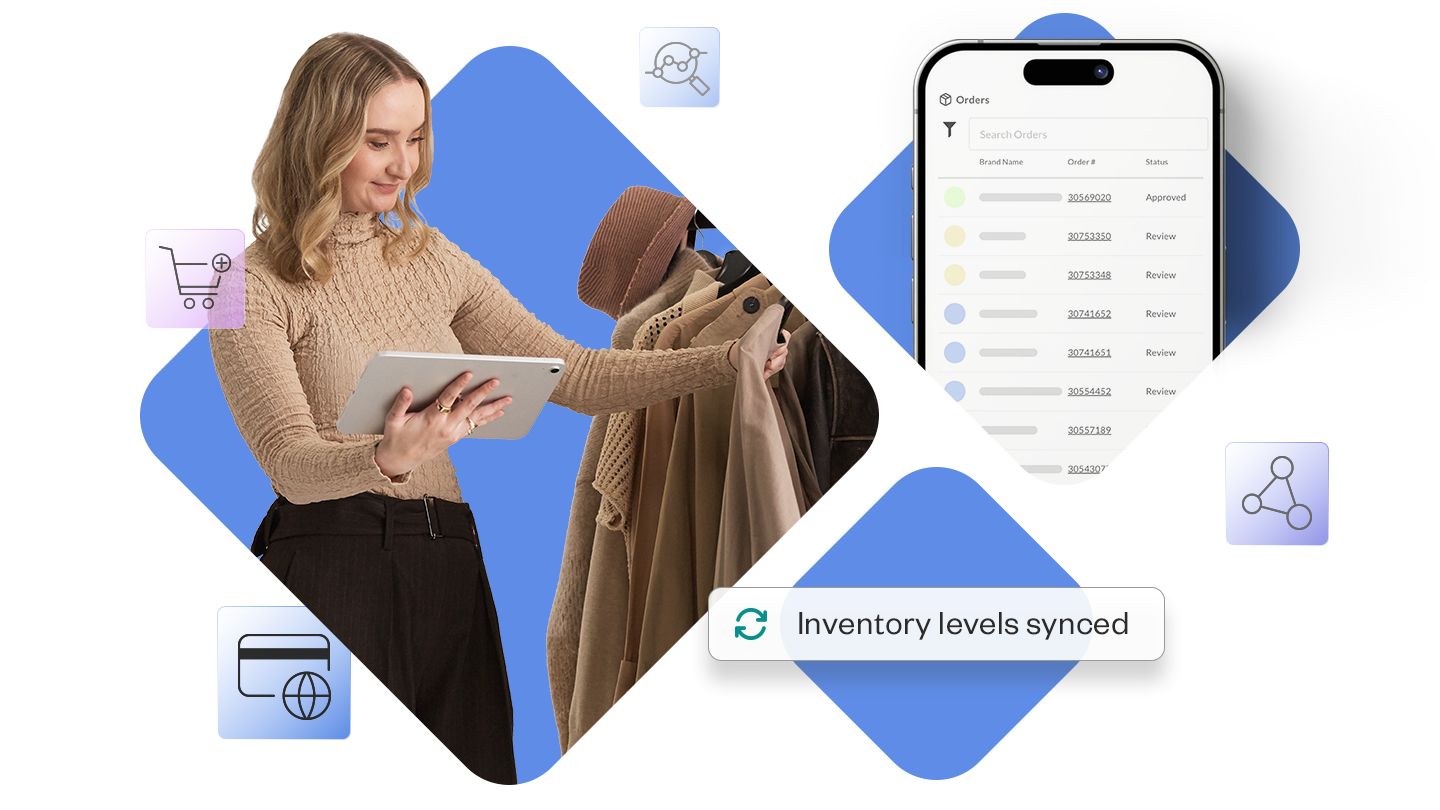
Wholesale has always been a relationship business—but the infrastructure behind those connections is changing. Brands still relying on phone calls, emailed PDFs, and printed line sheets are struggling to meet buyer expectations. If you're looking to digitize your wholesale business, the good news is that the playbook is proven.
Why should your business move wholesale online?
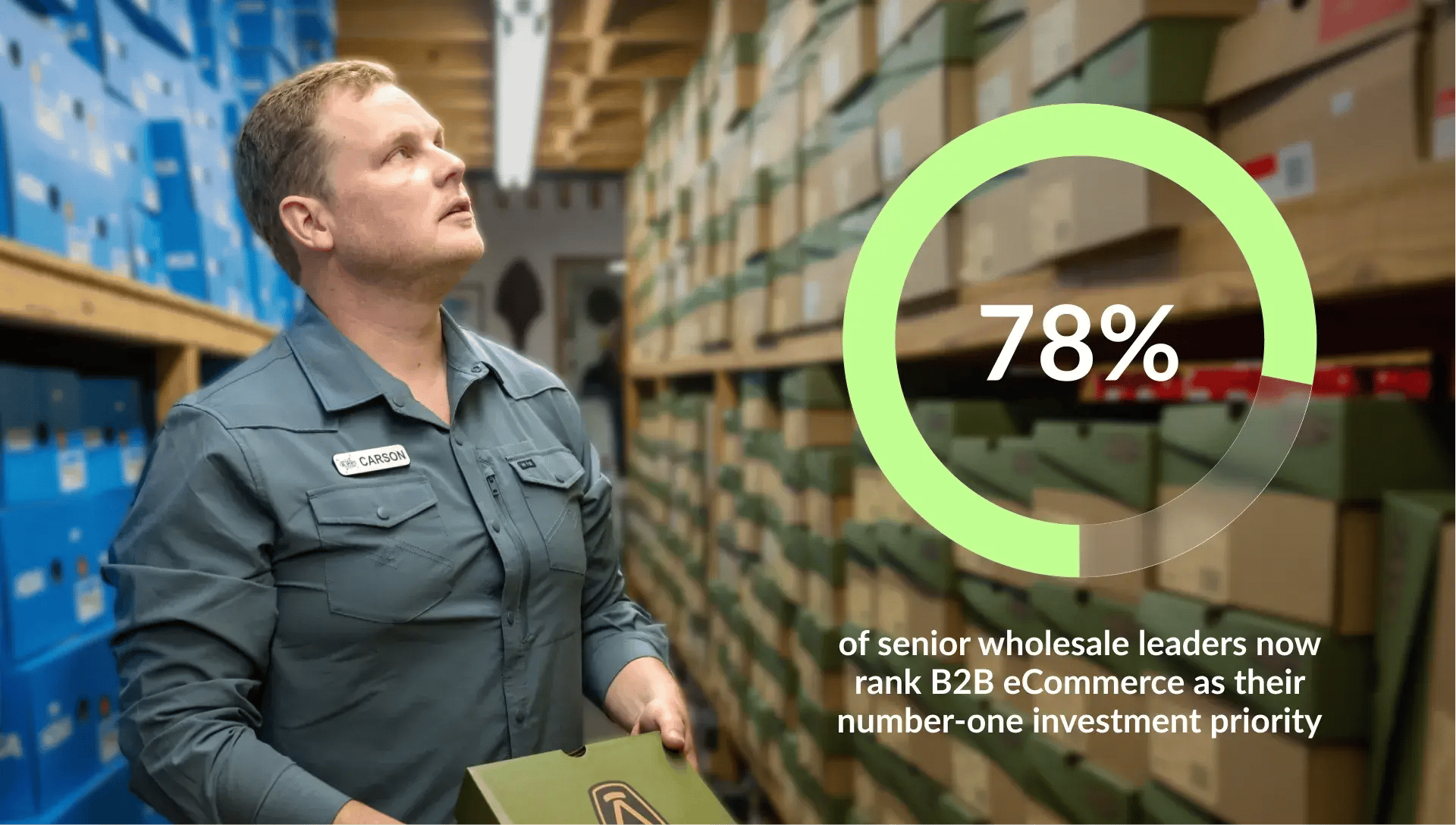
If you’ve been weighing whether to digitize your wholesale process, listen to what the industry is saying. According to NuORDER's 2026 State of B2B eCommerce Report, 78% of senior wholesale leaders now rank B2B eCommerce as their number-one investment priority. That figure has climbed year over year—and for good reason.
Digital wholesale cuts administrative costs by automating order entry, confirmation, and invoicing workflows that used to eat hours of manual labor. It accelerates fulfillment because orders flow directly into back-end systems without someone manually transferring data from an email into an ERP. It reduces errors—no more misread handwriting, duplicate entries, or pricing discrepancies that surface only after a shipment lands. And it gives buyers 24/7 control over their accounts and contract pricing, which is increasingly what retailers expect.
But digitization is more than just cost-cutting. The real unlock is what happens to your people. When reps stop spending their days rekeying orders, they start advising retailers on assortments, analyzing sell-through data, and growing accounts. Digitization is a powerful growth lever as much as it is an efficiency play.
The core pillars of wholesale digitization
Every brand's digitization journey looks different depending on category, scale, and existing tech stack. But the underlying building blocks remain consistent. These five pillars form the foundation of any digital wholesale operation—the structural “how” beneath the strategic “why.”
Self-service wholesale portals
A self-service wholesale portal is a branded, login-protected storefront where each buyer sees their specific contract pricing, negotiated discounts, order history, and available inventory. It’s the digital front door to your brand for every retail partner.
Buyers can browse your catalog, reorder from past invoices with a click, request quotes, and submit new orders—all without calling a rep or sending an email. Your team, in turn, stops rekeying orders from inboxes and starts focusing on higher-value work.
Research shows that B2B eCommerce platforms are becoming the primary channel for wholesale transactions, and those purpose-built for wholesale — unlike adapted B2C storefronts—account for the complexity of minimums, terms, and account-level rules.
For brands ready to move beyond trade-show-only selling, a wholesale portal is the single highest-impact investment. It turns episodic buying into an always-on, year-round channel.
Digital line sheets and virtual showrooms
The traditional line sheet — a static PDF of product images, pricing, and SKU details — served its purpose for decades. But it can't do what a digital line sheet can: update pricing in real time, filter by available-to-sell inventory, and let buyers add items to cart directly from the page.
Digital catalogs turn a passive reference document into a shoppable, interactive experience. Buyers filter by delivery window, category, or colorway. They view high-definition product imagery and 360-degree visuals. And they order right there—no switching between tools.
Virtual showrooms take this a step further, allowing brands to create immersive, branded presentations that replicate the energy of a physical showroom appointment for buyers who can't make the trip. Think shoppable video, product hotspots, curated collection narratives — all available 24/7.
The fashion brand Minimum, for example, used NuORDER's Virtual Showroom to run digital buying appointments with global retail partners—and achieved double-digit growth across three of four key markets.

ERP and back-end integration
A self-service portal is a major step forward, but it reaches its full potential when connected to your back-end systems. That means wiring the buyer-facing experience into your ERP, inventory management, OMS, and WMS so that prices, stock levels, and customer ledgers automatically update in real time, across every system, without a human touching it.
According to NuORDER's 2026 State of B2B eCommerce Report, only 9% of brands have achieved that level of seamless integration. This gap presents a major opportunity for competitive advantage—the brands that close it operate faster, sell more accurately, and make themselves far easier to buy from, whether the retailer is in Tokyo or Tampa.
NuORDER supports over 120 ERP and PLM integrations with two-way sync, meaning data flows bidirectionally between the wholesale platform and systems like SAP, NetSuite, Microsoft Dynamics, and Oracle. That bidirectional integration is what reduces overselling, eliminates manual data entry, and delivers on the promise of frictionless ordering.
AI and automation
For wholesale, the recent AI boom has already unleashed a range of operational advantages for brands. NuORDER's latest research found that 44% of wholesale leaders now use AI for inventory forecasting (up from 22% the prior year), 41% for process automation, and 38% for pricing optimization.
In practice, AI-powered wholesale can mean using algorithms to analyze a retailer's past purchasing patterns and surface personalized cross-sell and upsell recommendations; automated reorder triggers when a SKU dips below a set threshold; or demand forecasting that accounts for seasonality, regional trends, and sell-through velocity—helping brands produce efficiently based on market data, not instinct.
The brands getting this right aren't chasing AI for novelty. They're applying it where margins are won or lost: inventory accuracy, pricing discipline, and operational efficiency.
Hybrid and virtual selling
One of the most persistent objections to wholesale digitization is the fear that it replaces the sales rep. What it really replaces is the sales rep’s least favorite task: order-taker.
When routine reorders, catalog browsing, and invoice lookups move to self-service, reps are freed to do what they're best at: advising retailers on assortments, presenting new collections, and growing strategic accounts. Digital tools support this consultative shift directly: co-browsing sessions walking buyers through a virtual showroom, whiteboard tools for collaborative merchandising, and remote presentation capabilities that close deals from anywhere.
The net effect is a stronger sales team, spending more time on the work that grows accounts. Brands like Massimo Alba and Hammitt have found that digitizing their wholesale process actually strengthened retailer relationships by making their teams easier and faster to work with.
Share article


Get on the list
Wholesale tips and industry news you can’t miss, delivered weekly