---
title: Why wholesale leaders are doubling down on B2B eCommerce in 2026
description: A look at the major shifts defining the next chapter of wholesale in the 2026 State of B2B eCommerce Report.
image: https://blog.nuorder.com/hubfs/blog_b2breport26_hero_1x.webp
---
[](https://nuorder.com)

- Solutions
- [Brand](https://www.nuorder.com/wholesale/)
- [Department Stores](https://www.nuorder.com/assortments/)
- [Specialty Retailers](https://www.nuorder.com/wholesale-buying/)
- [⏩ **Watch on demand** Winning in Wholesale: Closing the Tech Gap](https://go.nuorder.com/winning-wholesale-closing-the-tech-gap?utm_campaign=Winning+in+wholesale&utm_medium=display&utm_source=www&utm_content=blog+nav)
- Products
- [Wholesale](https://www.nuorder.com/wholesale)
- [eCommerce](https://www.nuorder.com/wholesale/ecommerce/)
- [Advanced Sales Tools](https://www.nuorder.com/wholesale/advanced-sales-tools/)
- [Order Management](https://www.nuorder.com/wholesale/order-management/)
- [Flexible Configurations](https://www.nuorder.com/wholesale/flexible-configurations/)
- [Integrated Payments](https://www.nuorder.com/wholesale/integrated-payments/)
- [Actionable Insights](https://www.nuorder.com/wholesale/actionable-insights/)
- [Assortments](https://www.nuorder.com/assortments/)
- [For Brands](https://www.nuorder.com/assortments/brands/)
- [For Retailers](https://www.nuorder.com/assortments/retailers/)
- [Point of Sale](https://www.lightspeedhq.com/pos/retail/)
- [📖 **Get the Guide ** The Death of Disconnected Wholesale: Learn how wholesale has become more connected](https://go.nuorder.com/death-of-disconnected-wholesale-guide)
- Resources
- Resource Library
- [Case Studies](https://www.nuorder.com/resources-archive/#filter-case-study)
- [Blog](https://blog.nuorder.com/)
- [Knowledge Base](https://helpdesk.nuorder.com/hc/en-us/)
- [Learning & Support](https://learning-support.nuorder.com/)
- [📖 **NEW!** State of B2B eCommerce 2026: Wholesale Reengineered](https://go.nuorder.com/report-state-b2b-ecommerce-2026-wholesale-reengineered?utm_campaign=2026+b2b+report&utm_medium=display&utm_source=www&utm_content=blog+nav)
Log In
Get Started
Blog home B2B eCommerce Blog eCommerce tools All topics

## Blog menu
Blog home B2B eCommerce Blog eCommerce tools All topics

[ B2B ecommerce ](https://6465908.hs-sites.com/topic?slug=b2b-ecommerce&page=1)
# Why wholesale leaders are doubling down on B2B eCommerce in 2026
A look at the major shifts defining the next chapter of wholesale in the 2026 State of B2B eCommerce Report.

### Discover a better way to run your wholesale
[ Talk to our team **
](https://cta-service-cms2.hubspot.com/web-interactives/public/v1/track/click?encryptedPayload=AVxigLK26dqakqd%2FGfw8YDOhem1QoEDs7VL9UzC6foJig7hO%2F3kMQMzp6USlKsEZ0IQmM2cqePGYwdQdBbg0KKDZIYwtr9sHcIcTbPgU%2B1wL4NHySGVMsBNQto4jeX9wTIyGoUaoCoY5wHNN%2Fhyhvf03FkXxUfLOcLH18Mom%2FBxUrQ%2Bi&portalId=6465908)
For the better part of a decade, wholesale has been in reaction mode. DTC disruptors, a pandemic, tariff whiplash, elevated costs—the industry has spent years adapting on the fly. But something is shifting in 2026. Wholesale leaders aren't playing defence anymore.
Our 7th annual [State of B2B eCommerce Report](https://go.nuorder.com/report-state-b2b-ecommerce-2026-wholesale-reengineered) surveyed over 200 senior wholesale decision-makers and found an industry that’s grown up—approaching growth with discipline, conviction, and clear eyes. However, strategy has matured faster than infrastructure. We're calling this the “wholesale maturity gap,” and it's shaping the next chapter of B2B commerce.
Here are five major shifts we observed that every leader must plan for:
## 1. Growth, but now on the brand’s terms
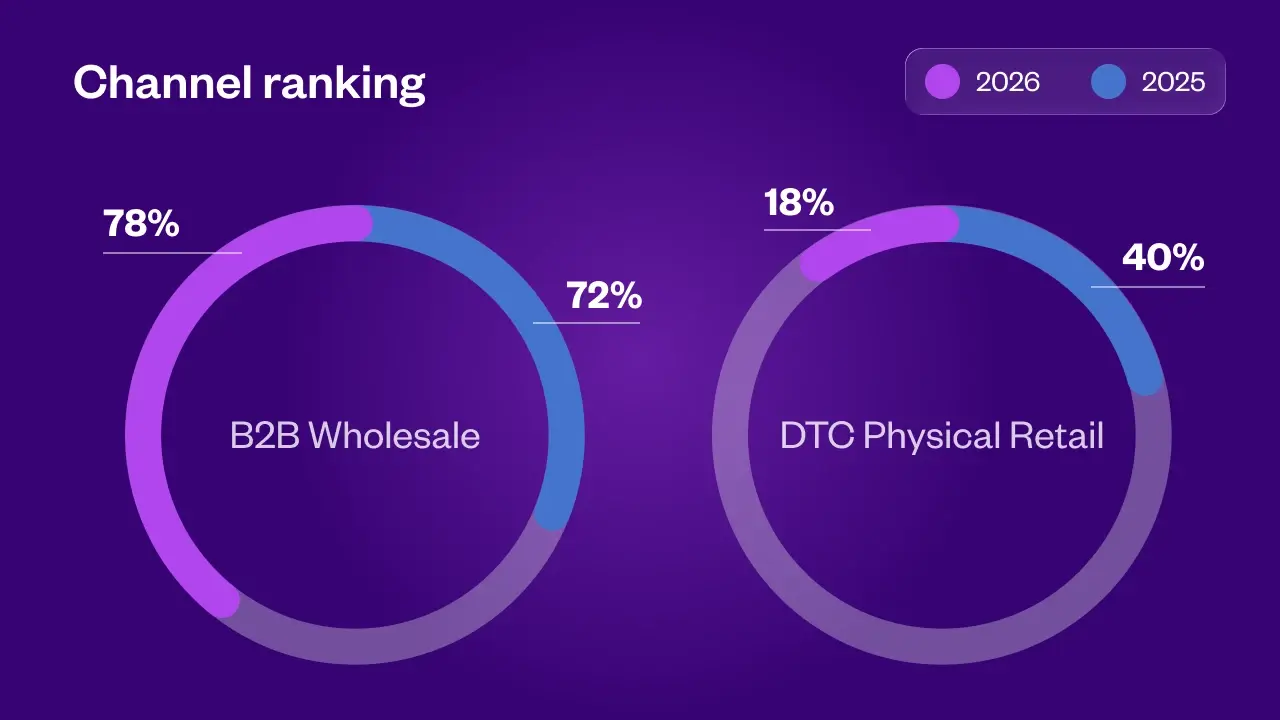
The era of growth-at-all-costs is over. In its place: disciplined, profitable expansion. A remarkable 78% of senior leaders now rank B2B wholesale as their #1 investment channel—up from 72% last year—while DTC physical retail fell from 40% to just 18%.
Wholesale offers greater control, and brands are leaning into levers they can actually pull. The report shows that 54% of leaders are prioritizing operational and supply chain cost reduction, 46% are investing in pricing flexibility, and 43% are working to improve margins through smarter retailer negotiations.
Expansion hasn’t slowed—it's just more intentional, with 52% focused on strengthening existing retail partnerships before chasing new ones. As Chris Akrimi, NuORDER’s VP of Supplier Network & B2B GTM, puts it: “It's precision over volume.”
## 2. The power of data and strengthening relationships
Sell-through visibility has taken a huge leap forward, moving from occasional insight to operational input. Medium visibility into retail sell-through jumped from 36% to 74% year over year, and 67% of brands now use that data frequently in daily decisions.
Armed with better sales insights, brands are finding their edge in relationship-led wholesale: showrooms, distributors, trade shows, in-person market appointments. While online-only channels may lag, B2B wholesale is growing by pairing richer data with deeper human connection.
## 3. The wholesale maturity gap is real, and growing
As wholesale has gotten more sophisticated, its underlying systems haven't kept up. Only 9% of those surveyed report fully integrated ERP systems with seamless data flow—down 16 points year over year. The other 86% are stitching things together with partial integrations and manual workarounds.
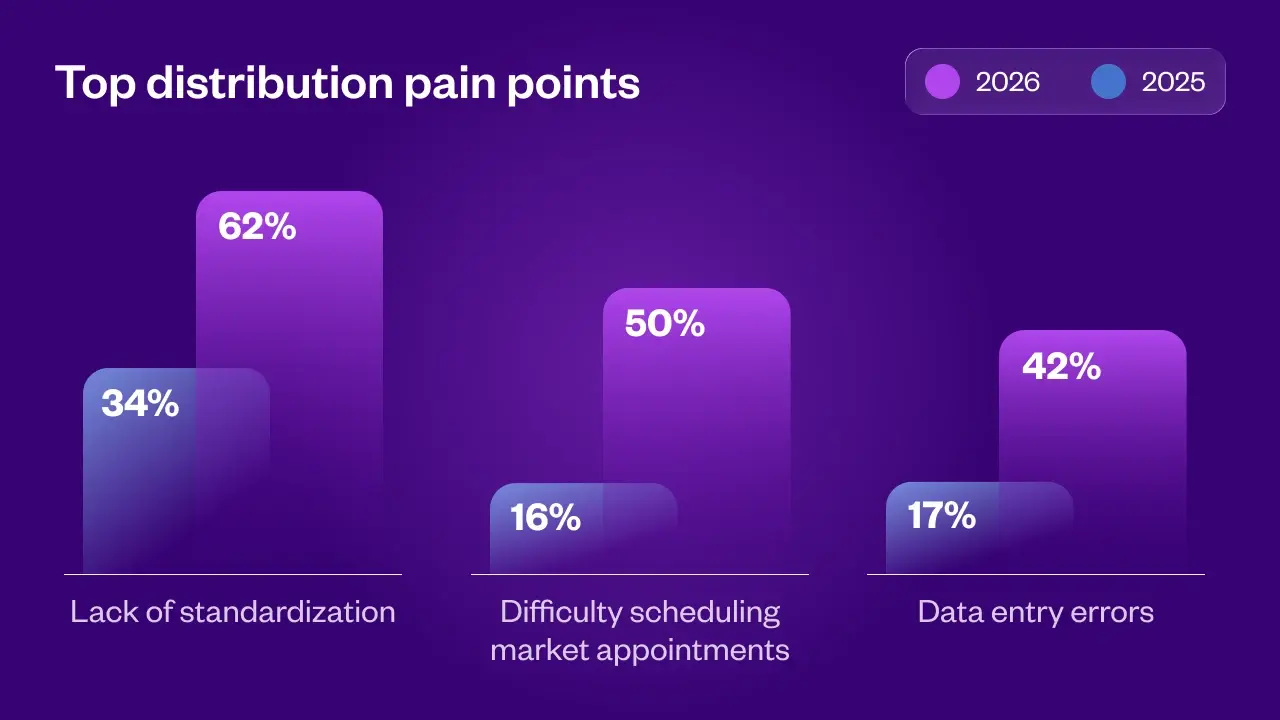
The downstream impacts on distribution are intensifying fast. Lack of standardization as a pain point climbed from 34% to 62%. Data entry errors or note-taking mistakes now plague 42% of brands (up from 17%). Difficulty scheduling market appointments jumped from 16% to 50%.
Marie Baldauf-Lenschen, NuORDER’s Director of Supplier Network Partnerships, calls the cost of all this the “Toggle Tax”—the drag on teams constantly jumping between disconnected systems, chasing down data, and manually bridging gaps that should have been closed long ago. In a business that runs on precision, that tax is getting harder to absorb.
## 4. AI is becoming a wholesale differentiator
You can't open a trade publication right now without tripping over an AI headline. Business of Fashion is tracking [how AI search engines move](https://www.businessoffashion.com/articles/retail/how-ai-will-shape-e-commerce-in-2026/) from product discovery to direct checkout, and Fashionista recently spotlighted how digital wholesale platforms—NuORDER among them—have [launched AI tools](https://fashionista.com/2025/10/ai-fashion-trend-forecasting-inventory-buying) to help brands optimize their buys and sustainability footprint.
Our data shows that wholesale leaders are putting AI to work where margins are won or lost. Inventory forecasting leads the way at 44% (up from 22% last year), followed by process automation (41%) and pricing optimization (38%, up from just 12%).
Wholesale brands aren’t chasing AI for AI’s sake or using it to replace creative judgment. They're using it to strengthen their operational backbones.
## 5. The smartest brands make it easy to collaborate
Across every theme in the report, one idea keeps surfacing: the brands winning in 2026 are the ones making themselves frictionless partners for retailers. They’re sharing [sell-through data](https://blog.nuorder.com/how-to-drive-sell-through-with-retailers) openly, collaborating on [assortment planning](https://www.nuorder.com/assortments/), offering 24/7 [digital ordering](https://www.nuorder.com/wholesale/order-management/), and tailoring product mixes to specific partners and regions.
As Tom Groves, Senior Director of Account Management at NuORDER, notes, some brands are explicitly aiming to be “the easiest wholesale brand to do business with.” [Arc'teryx](https://go.nuorder.com/case-study-arcteryx) is one example: the outdoor brand has publicly stated its goal of simplifying the buying process, and credits that mindset (and infrastructure) with 31% sales growth.
In a maturing industry, this ease of business might be the most durable advantage of all.
## See where your wholesale strategy stands
These shifts and takeaways only scratch the surface of our findings. Check out the full 2026 State of B2B eCommerce Report for insight into how wholesale veterans are solving for:
- Geographic diversification: Moving beyond North America and Western Europe to capture new demand in East and Southeast Asia
- Marketplace strategy: Using third-party platforms for reach and excess inventory without creating a dangerous dependency
- Supply chain adaptability: Moving from lean to adaptive models to manage real-time tracking and supplier diversification
- Sustainability standards: Shifting sustainability from a marketing headline to a pragmatic operational discipline
[Read the 2026 State of B2B eCommerce Report: Wholesale Reengineered 
](https://cta-service-cms2.hubspot.com/web-interactives/public/v1/track/click?encryptedPayload=AVxigLKzl7xIhg2oVSpmtsa22l7hhas2xL2XiIdXCZHZNq0niyWMU7ui3VSi9wXtlnogpAHKwjMUQaNYJhXUpM7H3b9LFat2NrtU6Swyjruc6ETcWgc9fmvEQWI%2FkyQMM%2B78wauN1T3PhzYW0hGgs0KCkjPplOTCGbCKvajN3dgvlXkfl4pJQoBK274cWRYGICj2W%2BoNG6BowVhllvZHI0vm1ra98UvPxeZYNciRXBGWWcFI&portalId=6465908)
Share article
[](https://www.instagram.com/nuorder/) [](https://www.instagram.com/nuorder/) [](https://www.facebook.com/NuORDERwholesale/) [](mailto:heroes@nuorder.com)
Inside this post 

## Related articles
[b2b ecommerce](https://6465908.hs-sites.com/topic?slug=b2b-ecommerce&page=1)
#### [ How do eCommerce tools improve operational efficiency? ](https://blog.nuorder.com/how-do-ecommerce-tools-improve-operational-efficiency)
[b2b ecommerce](https://6465908.hs-sites.com/topic?slug=b2b-ecommerce&page=1)
#### [ Why wholesale leaders are doubling down on B2B eCommerce in 2026 ](https://blog.nuorder.com/why-wholesale-leaders-are-doubling-down-on-b2b-ecommerce-in-2026)
[b2b ecommerce](https://6465908.hs-sites.com/topic?slug=b2b-ecommerce&page=1)
#### [ What does global eCommerce readiness look like? ](https://blog.nuorder.com/what-does-global-ecommerce-readiness-look-like)
[b2b ecommerce](https://6465908.hs-sites.com/topic?slug=b2b-ecommerce&page=1)
#### [ A practical guide to cross-border B2B eCommerce ](https://blog.nuorder.com/cross-border-ecommerce-for-b2b)
## Get on the list
Wholesale tips and industry news you can’t miss, delivered weekly
### Are you ready to *transform* your wholesale business?
See how NuORDER by Lightspeed can help you reach new heights.
[ Talk to an expert
](https://cta-service-cms2.hubspot.com/web-interactives/public/v1/track/click?encryptedPayload=AVxigLKTDTbBempP%2BRIjgS9pAHdxVMcaOeuSCue926M3eS2Rv%2BdhlcAIirVFnV1lTIGUbsza0Fi2DJZGmb5f94C0BOHDgW4mgifcbgw8devaI11srUFx5DCBpB0Lg4jOVK9Tv6D5DWpy68tMh6%2BJiSpfUiu6tmeWXBL5FV79tyUkVbdm&portalId=6465908)

Demo request
Log in
- Network
- [Exclusive Retailers](https://www.nuorder.com/exclusive-retailers)
- [Partner Program](https://www.nuorder.com/partners/)
- [Resources ](https://www.nuorder.com/resources-archive/)
- [Content Library](https://www.nuorder.com/resources-archive/)
- [Blog](https://blog.nuorder.com/)
- [Case Studies](https://www.nuorder.com/resources-archive/#filter-case-studies)
- [eBooks & Guides](https://www.nuorder.com/resources-archive/#filter-ebooks)
- [Webinars](https://www.nuorder.com/resources-archive/#filter-webinars)
- [Learning & Support](https://learning-support.nuorder.com/)
- [Knowledge Base](https://helpdesk.nuorder.com/hc/en-us/)
- Company
- [About Us](https://www.nuorder.com/about-us/)
- [Careers](https://www.lightspeedhq.com/careers/)
- [Contact Us](https://www.nuorder.com/contactus/)
- [Privacy Policy](https://www.lightspeedhq.com/legal/privacy-policy/)
- [Terms & Conditions](https://www.nuorder.com/terms-and-conditions/)
Get the latest wholesale tips and industry news from our blog delivered to your inbox.
@2025 NuORDER Inc. All Rights Reserved

- [Resources ](https://www.nuorder.com/resources-archive/)
- [Content Library](https://www.nuorder.com/resources-archive/)
- [Blog](https://blog.nuorder.com/)
- [Case Studies](https://www.nuorder.com/resources-archive/#filter-case-studies)
- [eBooks & Guides](https://www.nuorder.com/resources-archive/#filter-ebooks)
- [Webinars](https://www.nuorder.com/resources-archive/#filter-webinars)
- [Learning & Support](https://learning-support.nuorder.com/)
- [Knowledge Base](https://helpdesk.nuorder.com/hc/en-us/)
- Network
- [Exclusive Retailers](https://www.nuorder.com/exclusive-retailers)
- [Partner Program](https://www.nuorder.com/partners/)
- Company
- [About Us](https://www.nuorder.com/about-us/)
- [Careers](https://www.lightspeedhq.com/careers/)
- [Contact Us](https://www.nuorder.com/contactus/)
- [Privacy Policy](https://www.lightspeedhq.com/legal/privacy-policy/)
- [Terms & Conditions](https://www.nuorder.com/terms-and-conditions/)
Demo request
Log in
Get the latest wholesale tips and industry news from our blog delivered to your inbox.
@2025 NuORDER Inc. All Rights Reserved