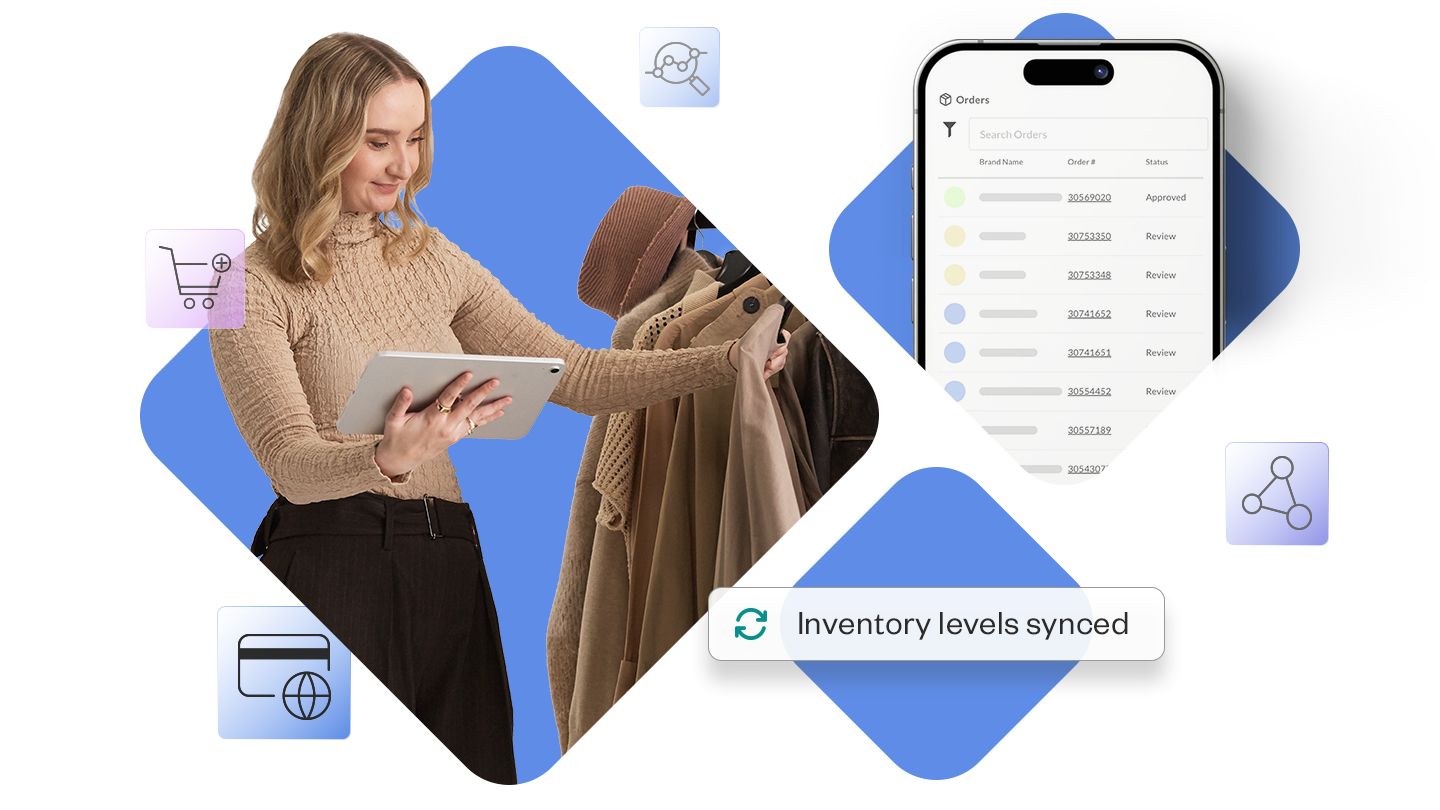
How do wholesale platforms improve assortment planning?
Learn how wholesale platforms improve assortment planning—centralize data, automate buys, and curb overbuying.

When your assortment planning process is built on spreadsheets and guesswork, you can easily end up facing overbuying, stockouts, and strained brand-retailer relationships. The best wholesale platforms help you improve assortment planning by centralizing real-time data, automating buys, visually representing your collections effectively, supporting effective B2B collaboration, and applying predictive analytics to optimize your product mix. Read on to discover how you can elevate your retail assortment planning with the right wholesale platform.
Key takeaways
-
The best wholesale platforms have the power to significantly improve your assortment planning
-
From visual assortment tools to omnichannel planning, the best platforms are designed to support the actual needs and intricacies of your wholesale business
-
These platforms make it easier to be more strategic about assortment planning while streamlining processes and saving team members’ time
What is assortment planning in wholesale?
Assortment planning is the process of deciding which products, in what quantities and variations, to carry across different channels, seasons, and deliveries to meet projected demand. Assortment planning in retail varies depending on whether it’s executed by a retailer or a brand. When it’s a retailer, they’re strategically planning the most effective wholesale buys, when it’s a brand, they’re deciding which collections and individual SKUs to stock in which of their wholly owned stores. Either way, it’s important to plan as effectively as possible to close the gap between what’s been purchased or stocked and what customers ultimately buy. That’s where wholesale platforms come in.
How wholesale platforms improve assortment planning
Explore the most powerful ways your wholesale platform can elevate your assortment planning.
Centralized, real-time data and predictive analytics
The best wholesale platforms integrate your POS, ERP, and eCommerce data into a single, live view. This helps you confirm what’s selling, and where, in real time. You can then use these rich insights to plan your assortments with greater accuracy, rather than via instinct and observation alone. You can also combine them with seasonal trend analyses, store-level insights, and industry-level insights to reduce risk even more.
Visual assortment building
Speed up your planning by using your assortment planning platform’s drag-and-drop tools. And build and organize collections to balance your categories, colors, and price points across deliveries via visual-rich representations that make them easy to both create and share with your teams. These powerful visuals also make it easy to spot duplicate styles and strengthen the cohesiveness of every collection.
Seamless B2B collaboration
When you use a wholesale platform, you can streamline communication between buyers, suppliers, and sales reps, with instant access to up-to-date availability. And brands can suggest optimized size curves and pre-grouped bundles so buys will be balanced from the start.
Omnichannel planning and store clustering
The right platform can support your multi-plan scenarios too. Your teams can use it to segment buys by channel (such as wholesale vs. DTC) and cluster stores by performance tier. This can help you ensure that your high-demand locations stay well-stocked while your lower-tier stores won’t end up mired in overstock.
Greater efficiency and speed
Wholesale platforms can also improve assortment planning by automating routine data entry tasks. It can mean the difference between having a minutes-long planning process instead of a weeks-long project. It’s a benefit that also frees up your team members’ time and energy to focus on more strategic buys.
"NuORDER has enabled us to remain connected and to collaborate with our buyers better than we ever have in the past. Now, more than ever, we are benefiting from buyers’ ability to quickly access our linesheets, lookbooks, and online ordering. The easy to use platform allows us to have an immersive and very personalized online sales experience for all of our customers."
— the wholesale team at the fashion brand Chan Luu
Traditional vs. platform-driven assortment planning
Here’s a great reference of the major differences between traditional assortment planning and planning with a wholesale platform.
| Traditional Planning | Platform-Driven Planning | |
| Data source | Static spreadsheets, manual exports | Live POS, ERP, and eCommerce data in one view |
| Method | Style numbers and guesswork | Visual building and predictive analytics |
| Collaboration | Email threads, version conflicts | Real-time brand–buyer collaboration |
| Speed | Weeks of manual entry | Minutes; automated routine entries |
| Main risk | Overbuying, stockouts, duplicate styles | Balanced, demand-aligned assortments |
Plan smarter with NuORDER
The best wholesale platforms turn assortment planning into a data-driven, collaborative process. That’s why NuORDER was specifically designed to mirror the realities of the wholesale business, while taking collaborative commerce to new heights.
Assortment planning FAQs
Why is assortment planning so difficult for retailers?
Assortment planning is complex when retailers are uncertain about demand. They need to predict demand to minimize the gap between sell-in (what they buy from manufacturers and brands) and sell-out (what they ultimately sell to consumers). What’s more, fragmented data across systems, long lead times, and seasonality can further complicate their ability to accurately predict what will actually sell.
What are the factors influencing assortment planning?
Assortment planning is influenced by historical sales, seasonality and trends, channel mix, store or account tier, margin targets, and supplier lead times.
What are the key features of a wholesale assortment planning platform?
Centralized real-time data, visual assortment building, brand–buyer collaboration, demand forecasting, and omnichannel/multi-plan scenarios are the key features and capabilities of an assortment planning platform.
What are the benefits of using wholesale suppliers?
Wholesale suppliers offer a myriad of benefits to retailers. When buyers work with suppliers, they gain access to established brands and inventory, the ability to offer an exciting mix of products, better unit economics on volume, and streamlined reordering—especially when they use a great wholesale platform.
Share article


Related articles
Get on the list
Wholesale tips and industry news you can’t miss, delivered weekly